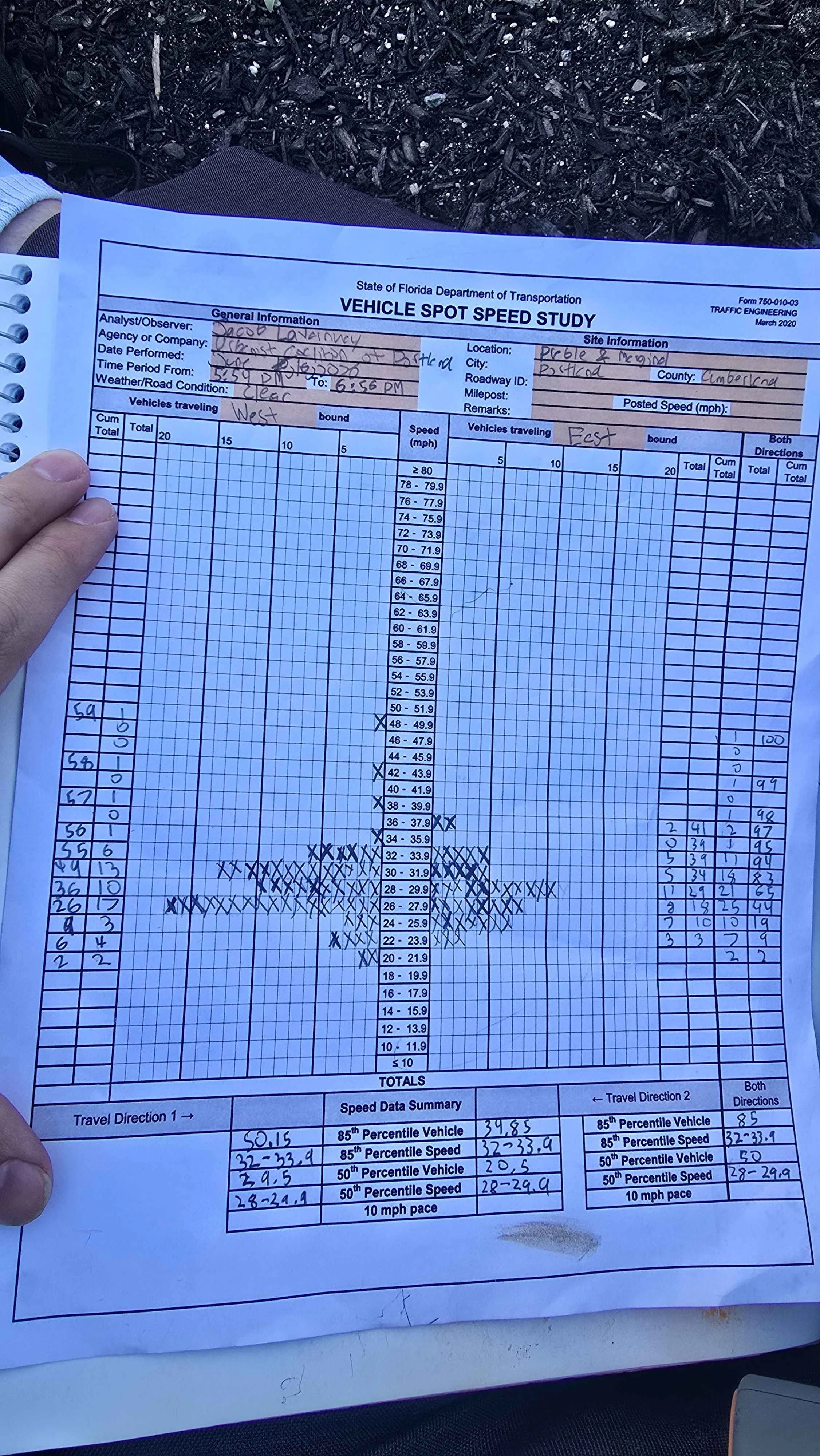
Measuring the speed of a deadly intersection
Earlier today, June 16, 2026, yet another Portlander was struck and killed by a car. This time, the fatality occurred at the intersection of Marginal Way & Preble Street, one of the most dangerous intersections in the city.
The most important part any response to a fatality is to not to assign blame to any individual party or behavior. It is most important to identify structural and systemic issues that increased the risk of a fatality.
Street and roadway design are the primary factors in traffic safety and vehicle speeds. A pedestrian struck by a vehicle traveling 30 MPH has a 40% chance of dying. Faster and larger vehicles also have longer braking distances, which greatly increases the likelihood of a collision. 20 MPH is the maximum speed at which cars can travel before pedestrian fatality rates begin to climb.
Before analysis of how much any change to the road design influences speeds, it is important to establish a baseline. Upon learning of the fatality, a volunteer from the Urbanist Coalition of Portland set out to conduct a speed study of the intersection at 6pm the same day.
Study Results
Over the course of one hour, 100 vehicles traveling east/west had their speeds taken. Of these, 98 vehicles were moving at speeds deadly to pedestrians. Only two were moving at 20 MPH or below.
The 85th percentile is a a metric used in traffic engineering to indicate the speed to which drivers felt comfortable moving at. The 85th percentile for this intersection is 32 - 33.9 MPH. In other words, drivers felt comfortable moving through this intersection at deadly speed. This is not okay. It should never feel natural to drive at lethal speeds on any stretch where pedestrians are present. We call upon the City of Portland to take immediate action and implement traffic calming measures at Marginal & Preble to drastically reduce vehicle speeds.